
Most agencies have never stood behind a register when the internet drops. We have. Hawkonix builds and operates Distrohawk, CornerHawk and CleanerHawk, so our POS and retail software development work starts from code and lessons that already run in real stores, warehouses and dry cleaning counters. We know what breaks at the counter, at the receiving dock and at end-of-day close, and we design for it before it happens.
That gives you two paths. If one of our products already fits how you sell, you can start on it this week and skip a long build. If your process is truly different, we design a custom POS or retail system around it, using the same stack, the same offline patterns and the same hardware integrations we ship in our own products.
Our three POS products, and who they fit
Distrohawk is for wholesale distributors such as smoke shop, vape and convenience suppliers. It combines a POS, back office, a branded B2B ordering website and an iOS/Android ordering app. It handles five price levels, case/pack/piece units, customer-specific pricing, credit limits and holds, invoices and collections, purchasing suggestions and 41 reports. Plans run $99, $179 and $249 per month, with a free trial of up to 3 months.
CornerHawk is for convenience stores, fuel stations, grocery, liquor and smoke shops. It covers the Daily Book end-of-day close, fuel and wetstock, lottery, tobacco scan data and rebates, vendor invoices with AI scan and EDI import, payroll and scheduling, and accounting. Plans are $59, $79 and $119 per store per month. CleanerHawk serves dry cleaners and laundries with counter tickets, garment barcode tags, plant production tracking, pickup and delivery routing and Stripe Terminal card readers, on plans of $79, $149 and $299 per month.
Offline POS that keeps selling when the internet drops
A register that stops when the connection blinks costs you sales and patience. Our offline POS approach stores the catalog, prices, tax rules and open tickets on the device, usually in IndexedDB for a progressive web app or SQLite for a native shell. Sales are written locally first, given a unique ID, and queued for sync.
When the connection returns, the queue pushes transactions to the server in order. The server treats each one as idempotent, so a retried upload never creates a duplicate sale. Inventory counts reconcile on the server, and conflicts, such as a price changed in the back office while a lane was offline, follow clear rules you agree to up front.
- Local-first sales with a visible sync status on screen
- Idempotent transaction upload, safe to retry
- Offline card handling rules set per your processor and risk tolerance
- Cached catalog, tax and price data refreshed in the background
Receipt printing, labels and card terminals
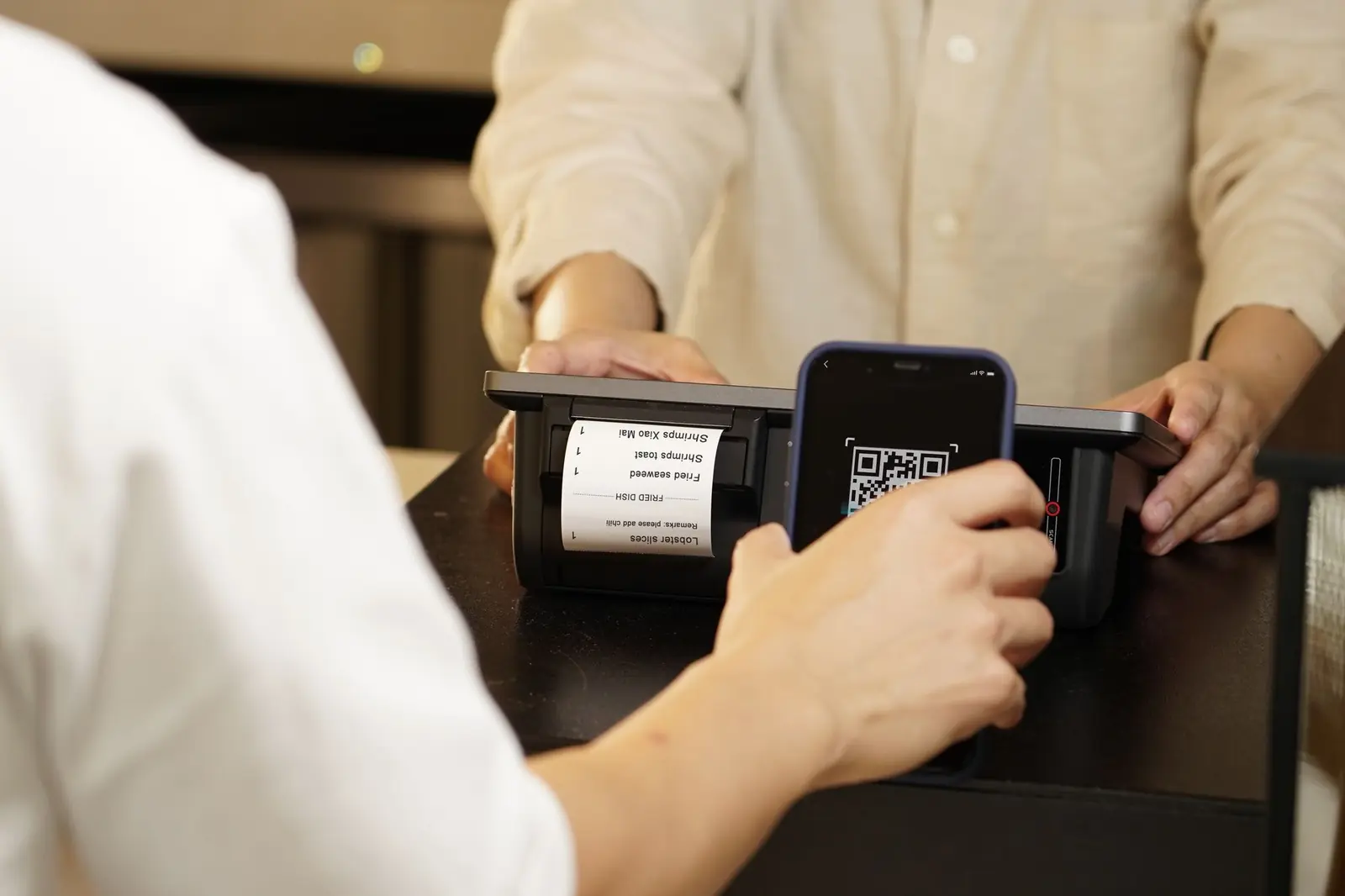
Hardware is where many retail projects slip. We integrate thermal receipt printers using ESC/POS commands, cash drawers kicked from the printer port, barcode scanners in keyboard or serial mode, scales, and label printers for shelf tags, price stickers and garment tags. In browser-based systems we use a small local print bridge or WebUSB where the device supports it, so printing stays fast and does not depend on a dialog box.
For payments, we prefer semi-integrated card terminals, where the terminal talks to the processor and your POS only sends the amount and receives the result. That keeps card data out of your software and shrinks your PCI scope. We have shipped Stripe Terminal readers in CleanerHawk, and we can work with other processors your business already uses, subject to their API and certification process.
Multi-store retail software and a real back office
Once you run more than one location, the back office matters as much as the register. Multi-store retail software needs a single product catalog with per-store prices where needed, stock by location, transfers between stores, purchase orders, vendor invoices and reports you can compare side by side.
We design the data model for this from day one: stores, registers, shifts and users with role-based permissions, so a cashier, a store manager and an owner each see what they should. End-of-day close, cash counts, over/short tracking and audit trails are part of the design, not add-ons. Reports run on the server against clean data, and exports go to your accountant in formats they can use.
- Central catalog with per-store pricing and stock
- Transfers, purchase orders and receiving
- Shift close, cash counts and audit logs
- Permission roles for cashier, manager and owner
POS and retail software development: our product or a custom build?
Start with one of our products if your business looks like the customers it was built for. A convenience store, a wholesale distributor or a dry cleaner will usually get further, faster and for less on CornerHawk, Distrohawk or CleanerHawk than on a new build. You also get updates we ship for every customer. If you need a few extra features, we can discuss adding them to the product roadmap or building an integration around it.
A custom build makes sense when your workflow is the competitive edge: an unusual pricing model, a mix of retail and service work, deep ties to an existing ERP, or rules that no packaged product handles. It also fits when you need to own the code outright. We will tell you honestly which path fits during discovery, even if the answer is a subscription rather than a project.